The Holy Sepulchre,
Sheep Street, Northampton, NN1
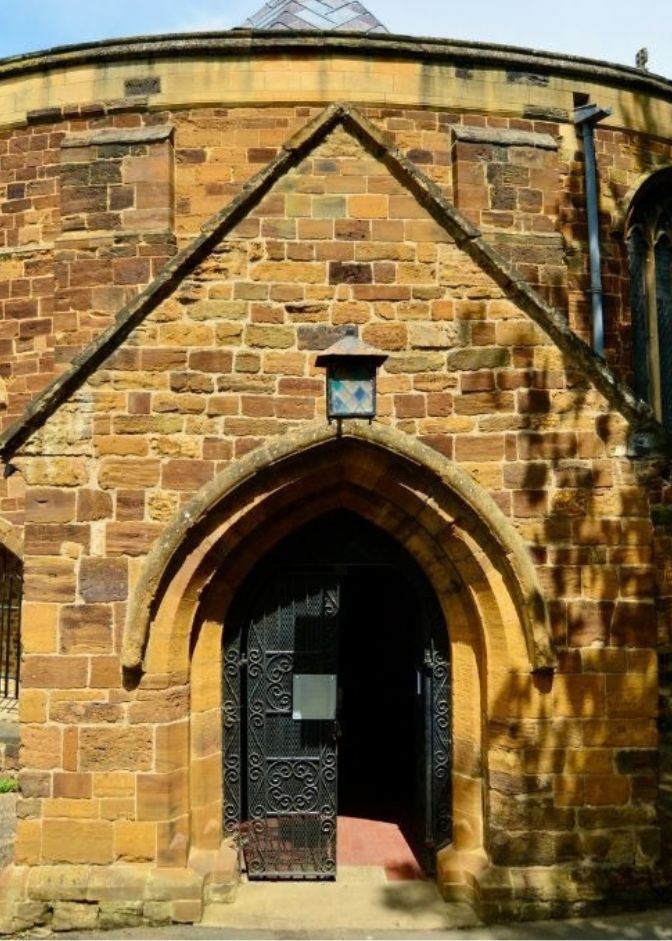
HISTORY
1100 AD – 1175 AD
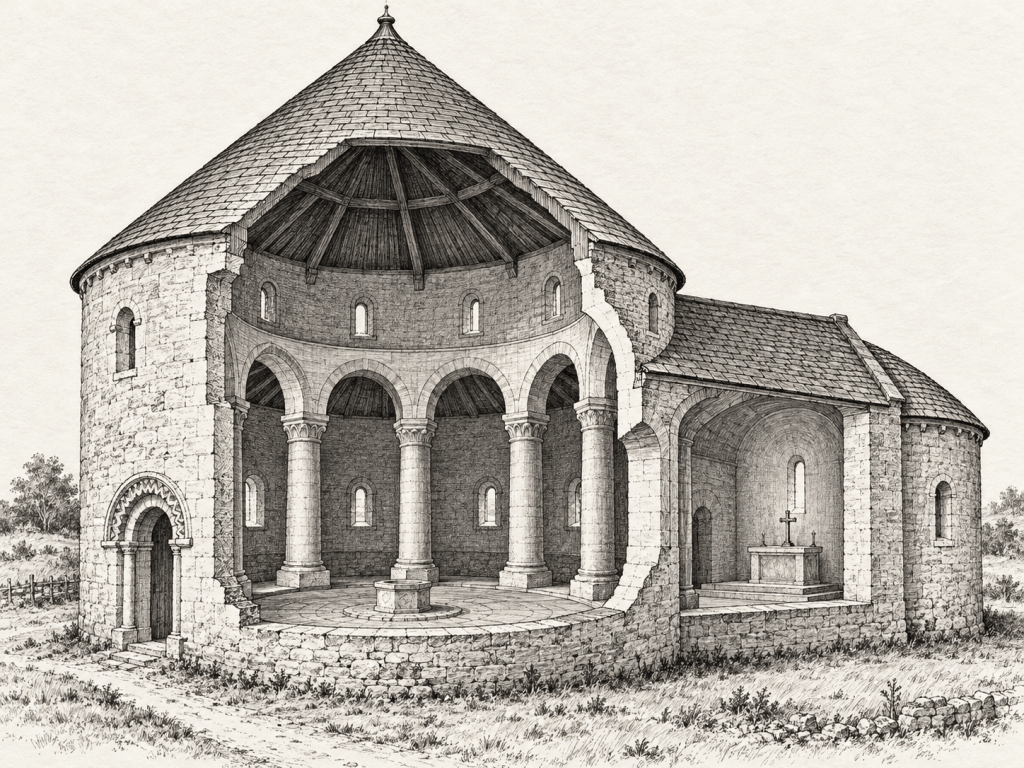
The Church of the Holy Sepulchre in Northampton dates to around 1100 AD and is traditionally attributed to Simon de Senlis (St Liz), 1st Earl of Northampton, one of the town’s most influential Norman lords. Associated with the First Crusade, Simon is believed to have been inspired by the Church of the Holy Sepulchre in Jerusalem, the traditional site of Christ’s burial and resurrection. He commissioned a remarkable circular church in Northampton, designed to reflect the sacred architecture of Jerusalem. The original Norman building was considerably smaller than the church we see today. Its circular nave contained eight substantial stone columns supporting rounded arches and an upper gallery, with an ambulatory running around the outside. To the east stood a short chancel, probably ending in a semicircular apse containing the altar. The church would have been illuminated by narrow Romanesque windows, while carved stone capitals and decorative features adorned its interior.
By the early 12th century, the church had come under the care of the Cluniac Priory of St Andrew’s in Northampton, founded by Simon de Senlis and his wife, Maud. The church is recorded as having been granted to the priory by around 1115, giving the monks responsibility for providing clergy and overseeing religious worship. The day-to-day services were conducted by chaplains supplied by the priory, rather than by the Knights Templar, with whom round churches are often associated. Throughout the period to 1175, the Holy Sepulchre served the religious needs of Northampton’s growing Norman community, providing a place for Mass, prayer and Christian worship.
Artists Impression – The Church Circa 1100 AD
1175 AD – 1275 AD
By the late 12th century, the Church of the Holy Sepulchre had stood in Northampton for almost eighty years. Originally constructed around 1100 AD under the patronage of Simon de Senlis, 1st Earl of Northampton, the church consisted of its distinctive circular nave, supported by eight Norman stone columns, and a short eastern chancel. As Northampton developed into an important medieval town, the church began to undergo its first significant architectural changes.
Around 1180 AD, a new north aisle (Now the Inner North Aisle) was added alongside the original chancel, marking the first major expansion of the Norman building. Two rounded arches were opened through the northern wall, supported by a central stone column, creating an arcade connecting the new aisle with the existing church. This additional space allowed the church to accommodate more worshippers and reflected the changing needs of its parish community. Remarkably, the original arcade survives today, providing a visible reminder of this early medieval enlargement.
The church remained associated with the Cluniac Priory of St Andrew’s in Northampton, which had provided chaplains to conduct services since the early 12th century. In 1226, the Bishop of Lincoln established a permanent vicarage, providing a resident priest with a fixed stipend and marking an important development in the church’s administration and parish life.
1275 AD – 1375 AD
By the late 13th century, the Church of the Holy Sepulchre had already undergone considerable changes since its foundation around 1100 AD. The original circular Norman nave, with its eight substantial stone columns, remained the most distinctive feature of the building. However, the addition of the inner north aisle around 1180 had begun to transform the eastern part of the church. Around 1275, a second, outer north aisle was constructed, running parallel to the earlier aisle and chancel. This was another significant enlargement, extending the church further north and creating additional space for worship. The new aisle would have been connected to the earlier addition by an arcade of stone arches, gradually changing the appearance of the church from a simple circular Norman structure into a larger medieval parish church.
Throughout the late 13th and 14th centuries, the Holy Sepulchre continued to serve Northampton’s growing community. The original round nave remained in use, while the enlarged eastern section provided additional space for religious services, prayer and parish activities. Architecturally, the church now displayed a mixture of its original Norman Romanesque features and the developing Gothic style of the later medieval period. By the end of the 14th century, the church had evolved considerably from Simon de Senlis’s original foundation, although its circular nave remained at the heart of the building.
1375 AD – 18th CENTURY
further significant alterations followed during the 14th and early 15th centuries. A new south aisle was constructed alongside the original chancel, creating additional space for worship and giving the building a much broader appearance. The original upper gallery of the circular nave was also replaced by a clerestory, with new windows admitting more daylight into the round church. Perhaps the most striking addition was the western tower and spire, built against the original circular nave, replacing its earlier western entrance and dramatically changing the church’s appearance. These alterations gradually transformed the small Norman foundation into a substantial medieval parish church, while preserving its distinctive circular centre.
During the following centuries, however, the church experienced a period of decline. By the 16th and 17th centuries, parts of the enlarged eastern building had deteriorated, and the outer north aisle and portions of the chancel were eventually demolished. By the 17th century, worship was largely confined to the original circular nave, while much of the remainder of the church stood neglected or had fallen out of use. Despite these changes, the Holy Sepulchre continued to serve its parish, and the medieval tower, circular nave and surviving aisles remained important features of Northampton’s historic townscape. By the beginning of the 19th century, the church was considerably altered from its medieval appearance and in need of substantial restoration, setting the scene for the major rebuilding undertaken by Sir George Gilbert Scott from 1860 onwards.
18th CENTURY – MODERN DAY
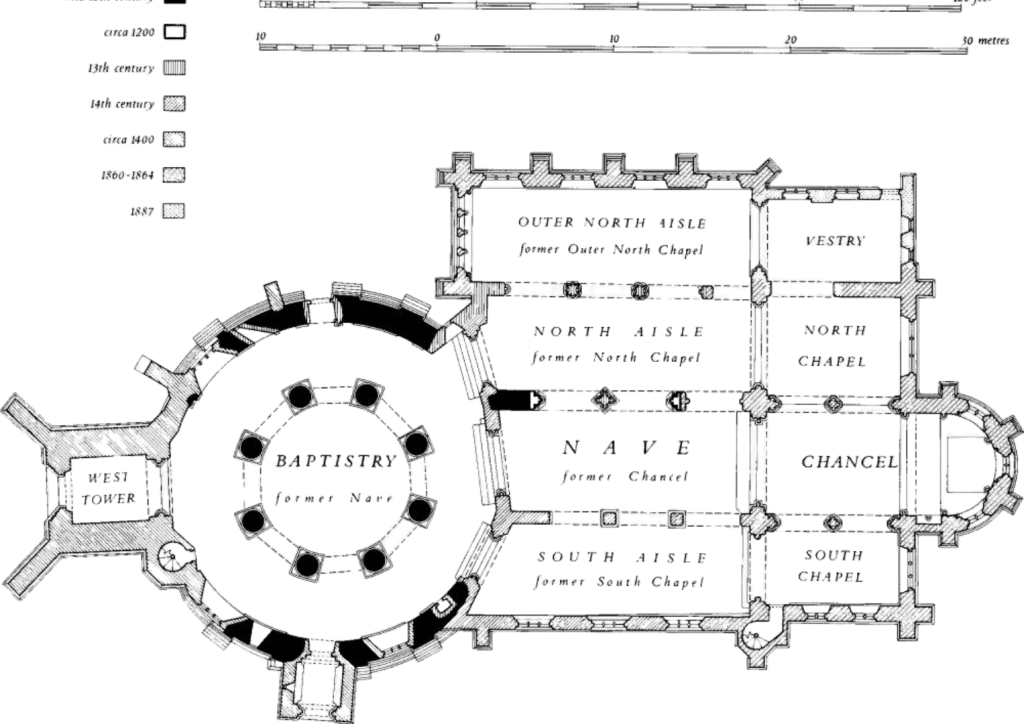
By the 18th century, the Church of the Holy Sepulchre had changed considerably from its original Norman appearance. Centuries of alterations, additions and the loss of parts of the medieval building had left the church in need of extensive repair. Although the original circular nave, medieval tower and surviving aisles remained, the eastern section had suffered particularly badly. It was during the 19th century that the church underwent its greatest transformation since the Middle Ages. Between 1860 and 1864, the renowned Victorian architect Sir George Gilbert Scott undertook a major restoration and enlargement, extending the church eastwards with a new chancel and adjoining chapels. Further restoration of the original Norman round nave followed between 1868 and 1873, with work continuing until 1879, when its surrounding aisle roof was replaced. In 1880, an ornate chancel screen designed by John Oldrid Scott was installed, while a new north vestry and organ chamber were added in 1887. These Victorian improvements helped establish much of the church’s appearance that visitors recognise today.
Throughout the 20th century, the Holy Sepulchre remained an important place of Christian worship and a significant part of Northampton’s architectural heritage. Its remarkable Norman circular nave, one of only a handful surviving in England, continued to attract historians, architectural enthusiasts and visitors from across the country. In 1952, the church was designated a Grade I listed building, recognising its exceptional historical and architectural importance. By the late 20th century, further conservation had become necessary, leading to a major programme of restoration which was completed in 2009 at a cost of approximately £1.2 million. Today, more than 900 years after its foundation, the Church of the Holy Sepulchre remains both a place of Christian worship and a treasured historic landmark. Visitors can still admire the original Norman columns and circular architecture, alongside the many medieval and Victorian additions that tell the story of its remarkable survival through nine centuries of Northampton’s history.
CONTACTS
Email – hello@holysepulchre.co.uk
Phone – 01604 627988

